
Picture a Dubai clinic that gets a WhatsApp message at 8 p.m. asking if a slot is free tomorrow. Nobody answers until morning. Slow WhatsApp replies cost UAE businesses customers because WhatsApp is the first channel UAE customers try, ahead of the phone, and they expect a fast answer in that thread. An unanswered message looks like a closed door, so the customer messages a competitor instead.
The market is moving the same way. A 2026 BCG-Meta study found 55% of large UAE organisations expect rich messaging, WhatsApp included, to be their top investment channel over the next five years (BCG-Meta coverage, Arabian Business). LuLu Hypermarket reported significantly higher engagement after moving key customer touchpoints to WhatsApp. Phone-first is the wrong default here, and a business that treats the phone as its front door is guarding the wrong entrance.
How to Structure Customer Response When WhatsApp Comes First
A UAE business should treat WhatsApp as its main front door and the phone line as a second door into the same conversation. That reverses how most support setups grew up, and it’s the root of good WhatsApp customer support in the UAE.
In a phone-first setup, the phone line gets a staffed queue, and WhatsApp gets whoever has a spare minute. Messages stack up in the evening, over lunch, and across weekends. The customer who wrote at 8 p.m. isn’t waiting patiently. They’re deciding.
Language adds a second layer. UAE customers routinely mix Arabic and English inside one message, and dialect matters. Gulf Khaleeji Arabic differs from the Modern Standard Arabic that generic tools default to. Bilingual handling is a baseline here, not a premium feature.
New entrants also hit a technical quirk. The UAE blocks WhatsApp’s in-app voice and video calling. Text, photos, voice notes, and documents all work normally. So a channel plan built around WhatsApp calling goes nowhere. Voice still matters, because some customers want to talk. It just has to run through a real business phone number, connected to the WhatsApp thread instead of sitting beside it as a separate system.
Phone-first is the wrong default for this market.

How VoiceVertex Solves WhatsApp-First Support
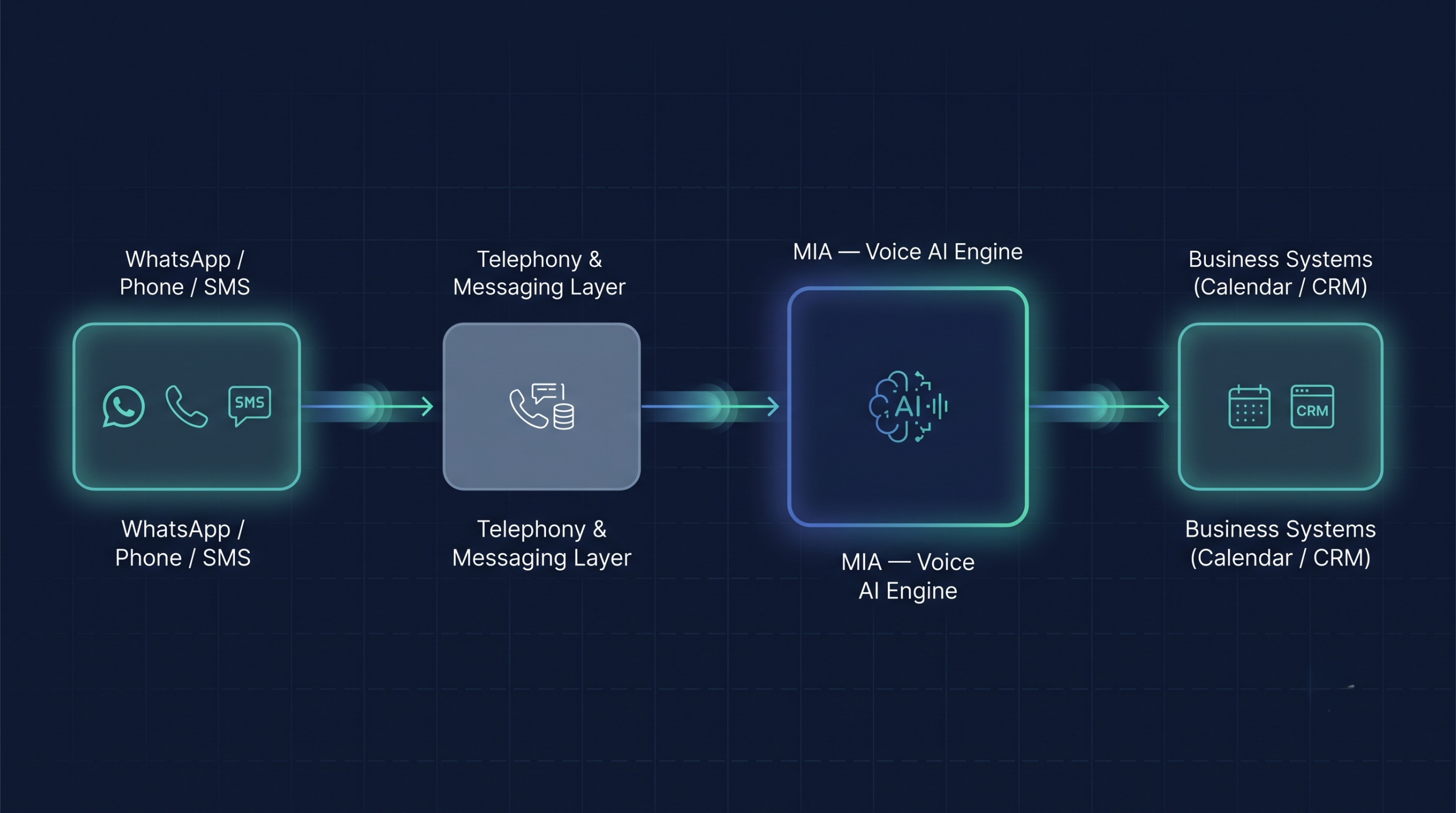
VoiceVertex solves this by running WhatsApp, phone, and SMS as one conversation, with MIA, its omnichannel AI receptionist, handling all three. Most setups treat a WhatsApp inbox, a phone line, and a language gap as three separate problems. MIA treats them as one. Here’s how that plays out for an AI agent for WhatsApp in the UAE.
Take the clinic customer from earlier. She messages at 8 p.m. in a mix of languages: “ممكن موعد tomorrow after 5?” That code-switched opening is how many UAE customers actually write. MIA replies straight away. Nobody on staff is online, and it doesn’t matter, because MIA answers every call and message instantly, any time.
Halfway through, she moves fully into Arabic. MIA follows immediately, with no transfer and no delay. If she drifts back to English, MIA follows again.
The next morning she’d rather talk than type. WhatsApp’s own calling won’t work here, so she rings the clinic’s regular phone number. MIA answers on real telephony, and the call picks up the same conversation. She doesn’t repeat her request or what she typed last night. Nothing gets lost between channels.
Nobody should repeat themselves just because they changed channels.
Then she asks something MIA can’t resolve. MIA hands the call to a staff member with everything said so far already attached, from the WhatsApp thread and from the phone call. The staff member isn’t guessing what happened. They can read it, and they start at the answer, not at hello.
For the business, the result is simple. Every message gets a reply. Every call gets an answer. Staff spend their time on the cases that need a person. The customer just meets a business that answered whenever they asked, in whatever language they used.
What This Means for Your Response Strategy
Build your response strategy around WhatsApp first, then add a real phone line that shares the same conversation. Measure WhatsApp response time in the UAE before you measure anything about the phone. Put your best coverage where customers actually start, including evenings and weekends. Aim for fewer missed messages and no customer explaining themselves twice.
Keep the phone line, though. Some customers want to talk, especially when a question feels urgent or complicated. WhatsApp calling isn’t an option in the UAE, so your business number is your only voice channel. A voice AI agent, connected to the WhatsApp thread, closes the gap. When you compare tools against a traditional answering service, ask one question: does the customer repeat themselves when they switch channels?
See MIA in Action
Curious how one conversation can follow a customer from WhatsApp to a phone call? See how MIA works at VoiceVertex.ai, whenever it suits you. No pressure, just a look at the real thing.
FAQ
Does WhatsApp calling work in the UAE?
No. WhatsApp’s in-app voice and video calling doesn’t work in the UAE. Text messages, photos, voice notes, and documents work normally. Businesses that want voice contact need a regular phone number working alongside their WhatsApp messaging.
Can MIA handle customers who switch between Arabic and English?
Yes. MIA switches language on request, immediately, with no transfer and no delay. The customer keeps the same conversation thread and never has to start over when the language changes.
Can an AI agent for WhatsApp in the UAE also handle phone calls?
With MIA, yes. A conversation can start on WhatsApp and finish on a real phone call, or the other way round. Nothing gets lost, and the customer never re-explains what they already said.
What happens when MIA can’t resolve a request?
MIA transfers the customer to a human team member with everything said so far already attached. The person picks up mid-conversation instead of asking the customer to explain the problem again.