Why the Empty Slot Costs More Than the No-Show
A 3 pm appointment sits on the schedule. The reminder call that should have gone out that morning never happened because the front desk was buried in a queue of walk-ins. The patient forgets. At 2:55 pm, the slot is still marked “confirmed” in the system, even though nobody has actually spoken to that patient in days. By 3:05 pm, it’s obvious the patient isn’t coming, but no one on the waitlist can get there in ten minutes. The no-show fee, if the clinic even charges one, covers a fraction of what that hour was worth.
The real cost isn’t the missed visit. It’s that the slot was never flagged as at-risk early enough to refill it. An unconfirmed booking that nobody notices until it’s too late is a bigger revenue problem than the no-show itself.
What Actually Happens During a Busy Period
Reminder calls are the first thing to slip when a clinic gets busy, and this isn’t a training problem. It’s a resourcing one. Front desk staff are juggling check-ins, phone queries, insurance questions, and walk-ins all at once. Calling every patient scheduled for tomorrow to confirm they’re still coming takes real time, and that time gets pushed to “later” until later never arrives. The call either goes out too close to the appointment to matter, or doesn’t go out at all.
A multilingual patient base makes this worse, not just more complicated. In Singapore, a single day’s schedule might include an English-speaking patient in the morning, a Mandarin-speaking elderly patient at midday, and a Malay- or Tamil-speaking family in the afternoon. If a clinic keeps one reminder script or relies on whichever staff member happens to be fluent in the right language at the right moment, confirmation calls for some patients get deprioritised simply because the person who can make that call is tied up elsewhere. The gap isn’t about willingness to communicate. It’s about the reminder workflow assuming a single-language default that doesn’t match who’s actually on the schedule that day.

How VoiceVertex Actually Solves This
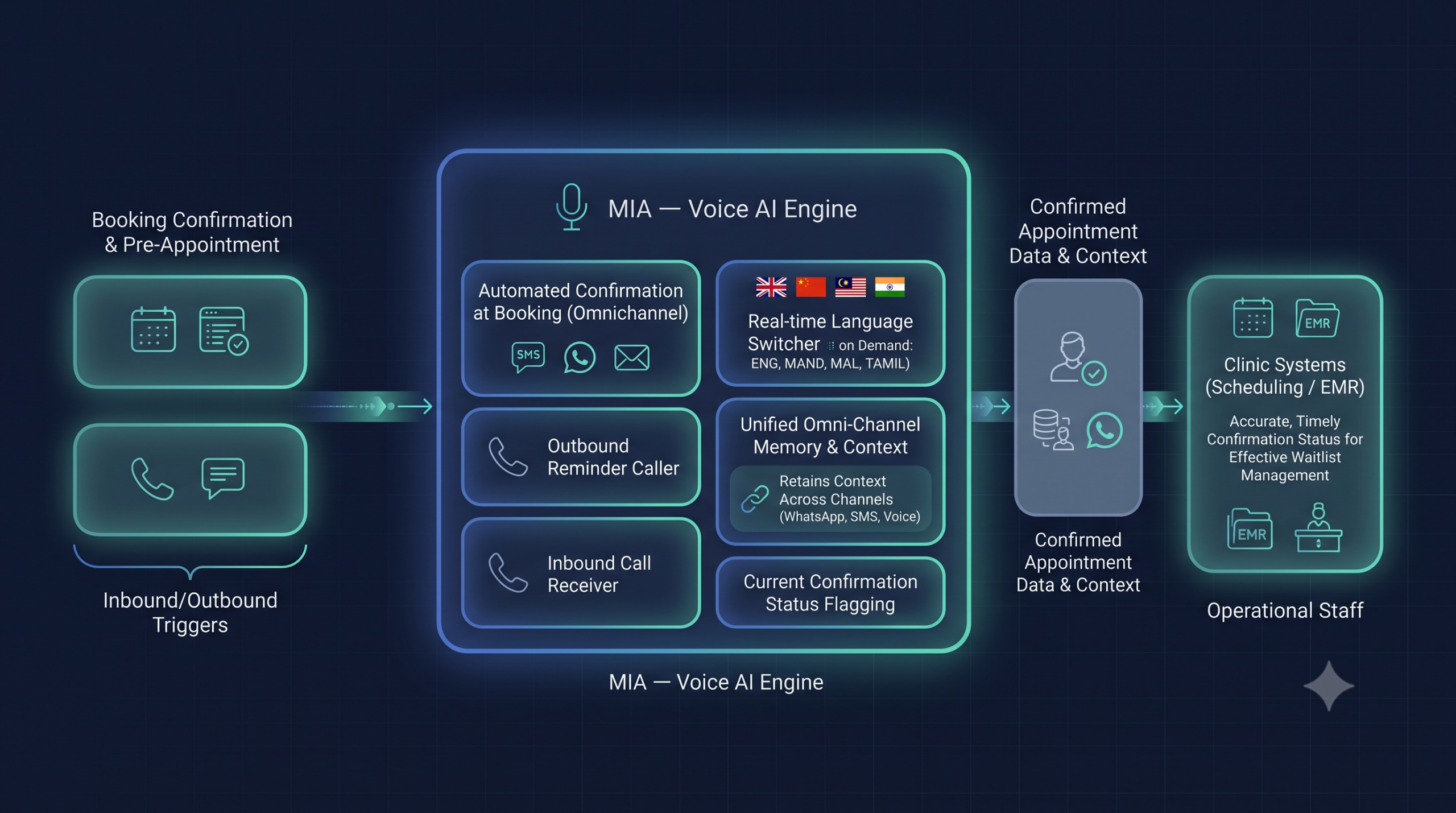
MIA closes this gap by handling the two moments that matter most: the confirmation at booking and the reminder as the appointment approaches. When a patient books, MIA sends an immediate confirmation, so there’s a written or spoken record of the appointment details from the start. Then, closer to the appointment date, MIA places the reminder call itself, without waiting for a free moment at the front desk. Because MIA handles both inbound and outbound calling, the reminder goes out on schedule regardless of how busy the clinic is that day.
Language is where this starts to matter in practice. If a patient answers in Mandarin and confirms their slot, MIA switches language on demand and completes the conversation in Mandarin, no transfer, no delay, no need to find a bilingual staff member. The same holds for Malay or Tamil. The patient isn’t asked to adapt to the clinic’s default language. The clinic’s reminder system adapts to the patient.
What happens next is where a lot of reminder systems break down. A patient might not pick up the reminder call, but later replies to a WhatsApp follow-up to confirm. With one memory across every channel, MIA already has the context from the earlier call attempt, so the patient isn’t asked to repeat their name, appointment time, or reason for visit. The conversation picks up where it left off, regardless of which channel it moves through. This is the difference between a voice AI agent and a simple chatbot: a chatbot only handles the channel it lives on, while MIA carries the same thread across voice, WhatsApp, and SMS.
The result is a confirmation status that’s actually current, not a guess based on whether someone got around to calling.
What This Means for Your Scheduling Process
The practical shift is knowing, hours in advance, which slots are genuinely confirmed and which are still open questions. That’s the window where a waitlisted patient can actually be called in to fill a slot that’s about to go empty. Without it, a clinic finds out a slot is unconfirmed at the same moment it becomes unfillable. With automated confirmation and reminders running in the background regardless of how busy the front desk gets, that window stays open long enough to act on it. The schedule stops being a record of intentions and starts being a reliable picture of who’s actually coming in.
See How This Works for Your Clinic
If unconfirmed slots are a recurring gap in your scheduling, it’s worth seeing how automated confirmation and reminders fit into your existing workflow. Learn more about VoiceVertex and how MIA handles it end to end.
FAQ
Why do appointment no-shows cost Singapore clinics more than the missed booking fee? The fee covers a fraction of the lost slot value. The bigger cost is that an unconfirmed booking often isn’t flagged as at-risk until it’s too late to fill from the waitlist, so the clinic loses the appointment and the chance to replace it.
Does sending reminders actually reduce no-shows? Yes. A 2016 meta-analysis in BMJ Open, pooling 21 studies, found patients who received reminder notifications were 25% less likely to miss appointments than those who received none. This is a well-established pattern across healthcare settings generally.
Can MIA handle a patient confirming in Mandarin, Malay, or Tamil? Yes. MIA switches language on demand during the conversation, so a patient confirming in Mandarin, Malay, or Tamil is handled directly without being transferred or asked to wait for a bilingual staff member.
What happens if a patient doesn’t answer the reminder call? MIA retains context across channels, so if the patient later confirms by WhatsApp or SMS instead, they don’t need to repeat their appointment details. The conversation continues from where the call left off.