Picture a strong candidate who applies to five companies on the same evening and accepts whichever one calls back first. Candidate screening speed matters more than screening depth in Indian hiring because the best candidates have options, and they take the first credible one. A deeper screen is worthless if the candidate has already said yes elsewhere.
Depth only matters for people you still have, and speed decides whether you still have them. The company that calls the next morning beats the better-run process that calls three days later. That isn’t candidates being disloyal. It’s how anyone chooses between real offers.
That’s our position, and we won’t hedge on it. In high-volume Indian hiring, get to the candidate first and get thorough second.
Where Candidate Screening Speed Breaks Down
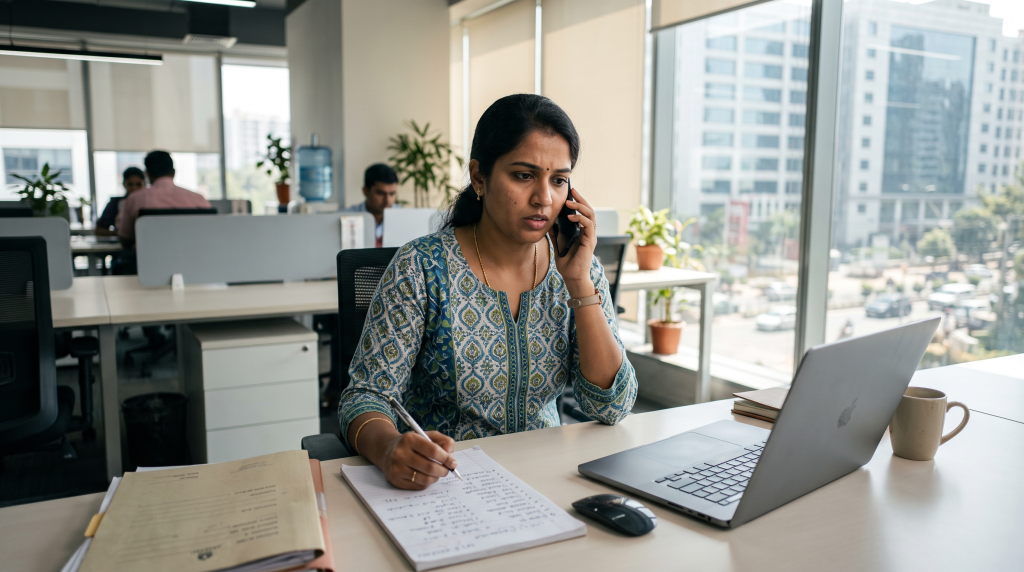
Here’s how a hiring drive goes wrong without anyone making a bad call. The job post goes live. Applications arrive in hundreds, then thousands. Three or four recruiters start dialling from the top of the list.
Some calls go unanswered, and each one needs a second try at a different time of day. By evening the team has reached a fraction of the list, and the rest becomes tomorrow’s job.
Tomorrow brings new applications on top of the old ones. The pile doesn’t shrink, it just gets re-sorted. Recruiters tend to prioritise strong-looking resumes, which pushes applicants with plainer resumes further down the list.
This is where “we’ll get to your application” quietly costs you. Candidates rarely complain. They just stop picking up, or pick up and say they’ve already joined somewhere else.
AI recruitment screening in India is no longer a fringe experiment. Per NASSCOM’s 2025-26 HR Tech Report, as cited in industry coverage, 78% of Indian BPO operators with more than 300 seats have adopted some form of AI-assisted screening or scheduling. That many operators moving in the same direction tells you where the pain is.
How VoiceVertex Actually Solves This
Indus Towers shows what changes when the calling stops being manual. It screened 10,000 applicants in 48 hours using AI phone screening, a scale and speed that manual calling can’t match. Industry reporting puts the cost gap between manual and AI screening at that volume at approximately ₹55-90 lakh per hiring cycle. That wasn’t a VoiceVertex deployment, and we’re not claiming its result for MIA. It does show what voice AI hiring in India can look like at scale, so here’s how MIA, VoiceVertex’s omnichannel AI receptionist, would run a drive like it.
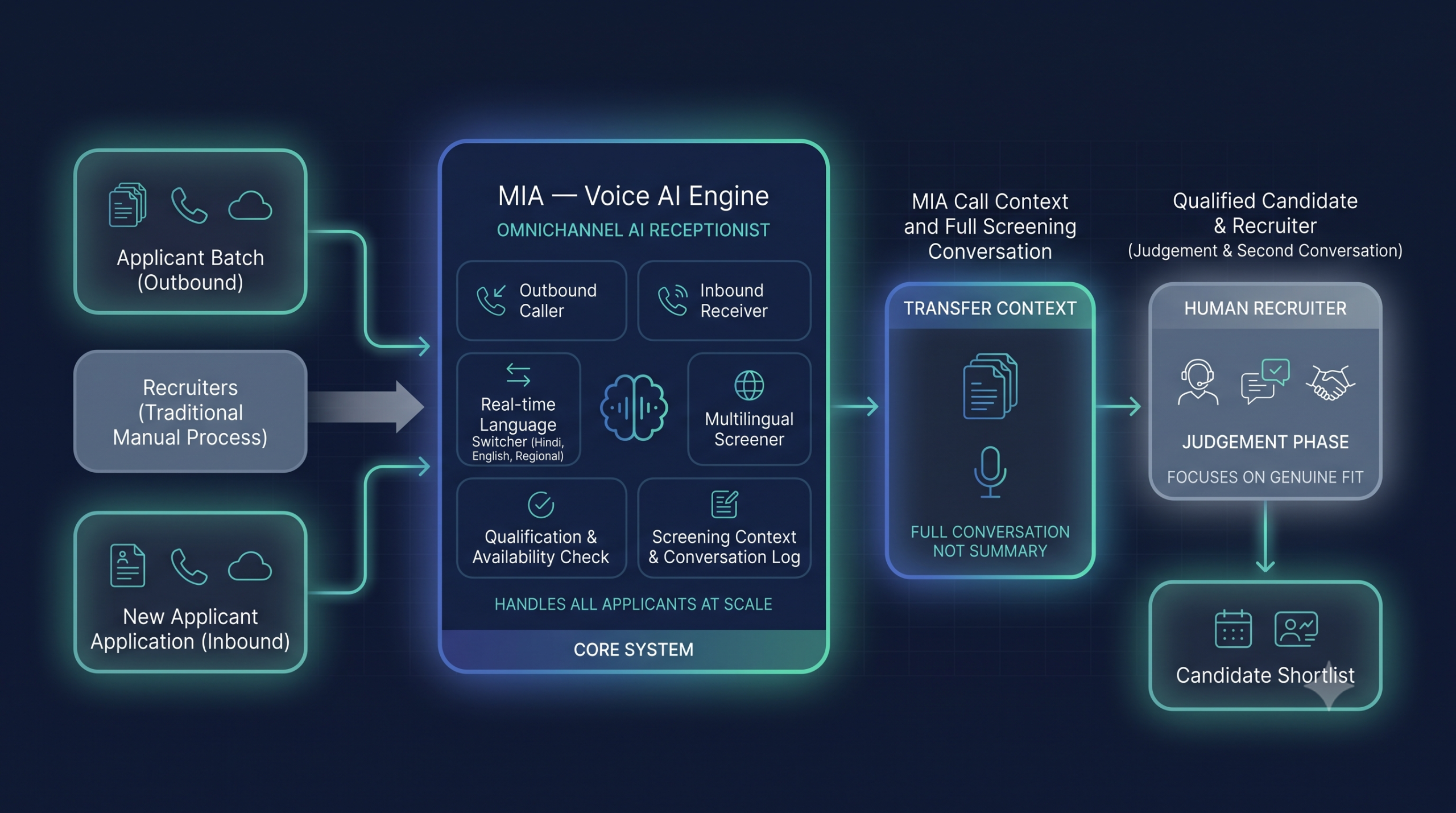
It starts with outbound. MIA handles both inbound and outbound calling, so once a batch of applicants is released, it can call them directly instead of waiting for a recruiter to reach row 300. The same MIA also picks up when a candidate calls back. If you’re new to how this works, our guide to voice AI agents covers the basics.
Voice AI Hiring in India: One Regional-Language Call, Start to Finish
Now take a candidate in a tier-2 city who picks up and is most comfortable in a regional language. Or one who starts in Hindi and moves into English for a technical term halfway through. MIA switches language on demand, so the conversation keeps going. There’s no transfer to another line and no “please hold for a Hindi speaker.”
Multilingual screening isn’t a premium feature in this market. It’s standard practice, because it’s how applicants actually speak.
A candidate reaches a recruiter only once they’ve qualified. When they do, MIA transfers the call to a human with context. The recruiter gets the full screening conversation, not a two-line summary, so nobody starts the questions again from zero.
Speed comes from MIA reaching everyone first. Judgement stays with your recruiters, where it belongs.
What This Means for Your Hiring Process
Start by changing what you measure. It’s easy to track how many candidates were screened this week. Track how long the median applicant waits for a first conversation instead. That number shows how many good candidates you lose before you meet them.
Next, stop asking the first call to do everything. Its job is to find out who’s qualified, available, and interested, quickly. Save the long conversation for the shortlist.
Then count the real cost: recruiter time, telephony, and calling-team churn, not just salaries. Weighing an outsourced desk instead? See our AI receptionist vs answering service comparison.
Finally, put your people where they add the most value: the second conversation, when a genuine fit talks to a recruiter who already knows what was said. That beats dialling.
See It Work
See how MIA handles a screening call, including a candidate who switches language halfway through, at voicevertex.ai. No pressure, no demo needed. Just take a look when it suits you and see if it fits.
FAQ
Can AI recruitment screening in India handle regional languages?
Yes. MIA switches language on demand, so a candidate who calls in Hindi, English, or a regional language is handled without a transfer or delay. For high-volume hiring in India, multilingual screening is standard practice.
Does AI screening replace my recruiters?
No. MIA handles the first round of calls. When a candidate qualifies or needs a real recruiter, the call transfers to a human with the full screening conversation attached, so nobody repeats questions.
Can MIA call candidates, or only answer inbound calls?
Both. MIA handles inbound and outbound calling, so it can call applicants directly at scale instead of waiting for them to call in. That’s what makes screening a large batch practical during a hiring drive.
What does manual phone screening cost in India?
Per SHRM India Benchmark Report figures reported in industry coverage, manual HR phone screening costs approximately ₹850-1,200 per candidate, including recruiter time, telephony, and recruiter-team attrition. An outsourced calling desk runs approximately ₹600-900.